Flight Delay Compensation: What You May Be Entitled To
U.S. airlines aren't required to compensate you for delayed domestic flights, but international flights covered by EU261 or Montreal Convention may qualify. Here's what to expect and when to ask.
Save it in this browser to find it later.
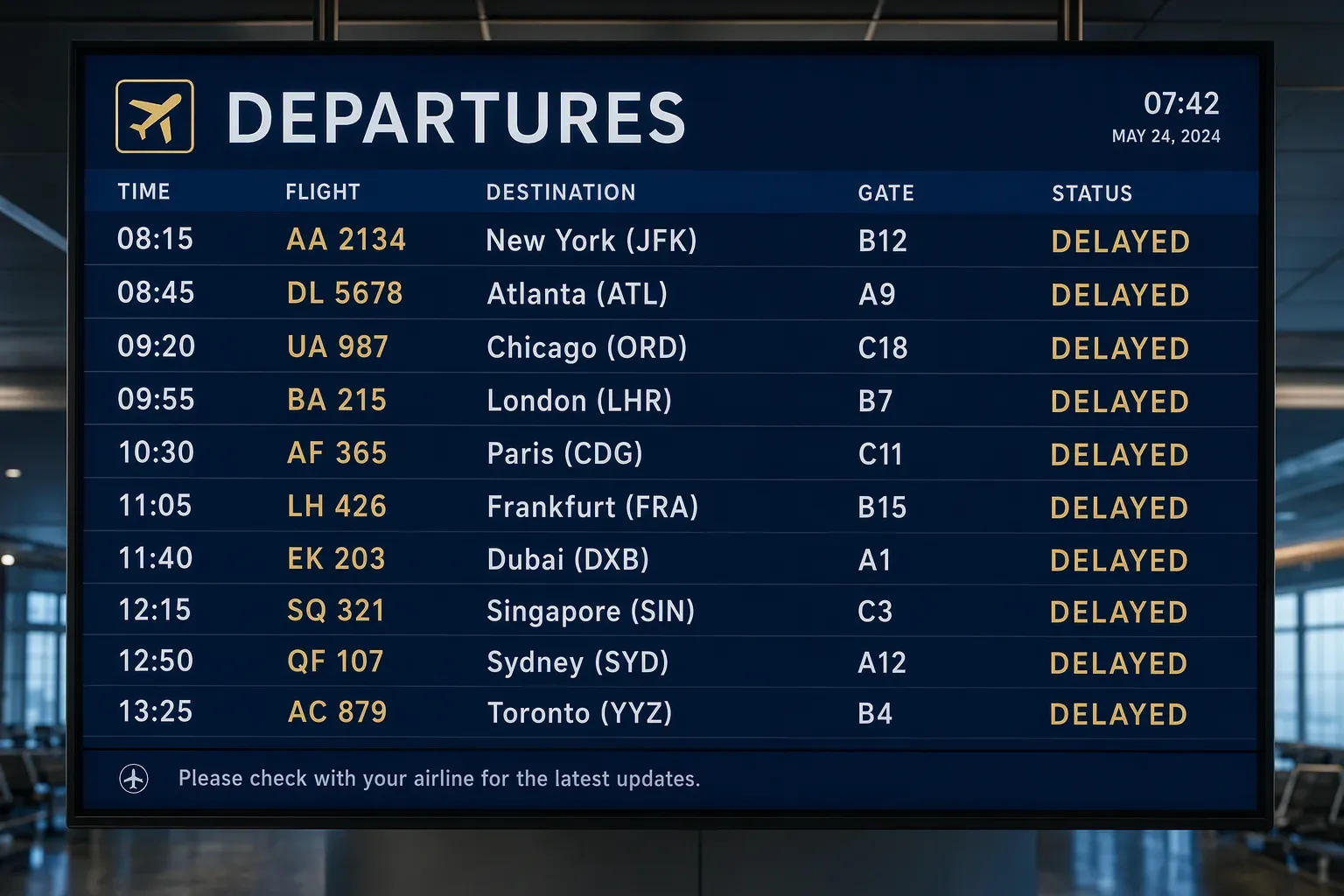
If your flight is delayed on a U.S. domestic route, the airline is not required to compensate you with money, though many carriers will provide meal vouchers, hotel rooms, or rebooking assistance for long delays caused by problems within their control. If your delayed flight is international—especially if it's covered by European Union regulation EU261 or the Montreal Convention—you may be entitled to fixed compensation ranging from a few hundred to several hundred euros or the equivalent, depending on the delay length and distance. The key distinction is where your flight operates and what caused the delay.
U.S. domestic flights: no compensation requirement
For flights within the United States, federal law does not require airlines to pay you money when your flight is delayed, no matter how long the delay lasts. The U.S. Department of Transportation sets rules for refunds, bumping, and baggage, but compensation for delay time itself is not mandated on domestic routes.
That said, many U.S. airlines commit to providing assistance during long delays, especially when the delay is within the airline's control. The DOT's airline customer service dashboard shows what each major carrier has pledged to provide for controllable delays and cancellations: meal vouchers after a certain number of hours, hotel accommodations if you're delayed overnight, and rebooking on the next available flight. These commitments vary by airline, so check the dashboard or ask the gate agent what your carrier's policy covers.
If the delay was caused by weather, air traffic control, or another reason outside the airline's control, most carriers do not commit to providing meals, hotels, or other expenses, though some may still offer help case by case.
International flights: EU261 and Montreal Convention
If your delayed flight is covered by European Union regulation 261/2004—commonly called EU261—you may be entitled to fixed compensation if the delay reaches your final destination three hours or more late. EU261 applies to flights departing from an EU airport on any airline, and flights arriving in the EU on an EU-based carrier. The compensation amount depends on the flight distance:
- €250 for flights up to 1,500 kilometers
- €400 for intra-EU flights over 1,500 kilometers and other flights between 1,500 and 3,500 kilometers
- €600 for flights over 3,500 kilometers
The regulation also requires the airline to provide meals, refreshments, and hotel accommodations during the delay, as well as two phone calls or emails. Compensation is not owed if the delay was caused by extraordinary circumstances outside the airline's control, such as severe weather, political instability, or air traffic restrictions, but the airline still must prove the cause qualifies.
For other international flights, the Montreal Convention may apply. This treaty governs liability for delays on international air travel, but it focuses on damages you can prove—expenses you incurred because of the delay—rather than fixed compensation. If a delay caused you to miss a prepaid hotel night, lose income, or incur other documented costs, you may be able to claim reimbursement, but you'll need receipts and evidence. The Montreal Convention sets liability limits and lets airlines avoid damages if they took all reasonable measures to prevent the delay.
Sky Stuck's guide to international flight rights explains which routes and carriers are covered by EU261 and Montreal Convention rules, and what documentation you need to file a claim.
What U.S. airlines typically offer for long delays
Even though compensation isn't required, U.S. airlines often provide assistance when delays stretch for hours, particularly when the cause is within the airline's control—maintenance, crew scheduling, or an aircraft swap, for example.
Meal vouchers. Many carriers commit to providing a meal voucher if the controllable delay exceeds a certain threshold, often two to three hours. The voucher amount and where you can use it vary by airline and airport. Ask the gate agent whether meal vouchers are available; they won't always announce it, and policies differ by carrier.
Hotel accommodations. If a controllable delay forces an overnight stay, most major U.S. airlines commit to providing a hotel room or a hotel voucher. Some also cover transportation between the airport and the hotel. If the delay was due to weather or air traffic control, hotels are usually not provided, though some airlines may help on a discretionary basis if rooms and budget allow.
Rebooking on the next flight. When a delay becomes long enough that you'd rather take a different flight, airlines will typically rebook you on the next available flight to your destination at no extra charge, including on a partner airline if seats are available. The earlier you ask, the better your chances of getting a seat that works.
Refund if you choose not to travel. If the delay is significant and you decide not to fly at all, U.S. DOT rules say you're entitled to a refund for the unused portion of your ticket. The airline may try to offer a voucher, but you can request a refund to your original payment method instead.
The DOT's customer service dashboard lists each airline's specific commitments, updated periodically. It's worth checking before your trip or bookmarking on your phone so you know what to expect if a delay happens.
How to find out if your delay qualifies for compensation
If you think your delayed flight may be covered by EU261 or another international rule, here's how to check:
Where did the flight operate? EU261 applies to flights departing from an EU airport on any airline, and flights arriving in the EU on an EU-based carrier. If your delayed flight meets one of those conditions, EU261 may apply. If your flight was international but doesn't fit EU261's scope, the Montreal Convention governs damages, but you'll need to prove your costs.
How late did you arrive at your final destination? EU261 compensation is based on the delay at your final destination, not at an intermediate stop. If your first flight was delayed but you still reached your final destination less than three hours late, compensation typically isn't owed. If your connection caused you to arrive three or more hours late, it may qualify.
What caused the delay? Airlines do not owe EU261 compensation if the delay resulted from extraordinary circumstances like severe weather, security risks, or air traffic restrictions. The airline must demonstrate that the cause was outside its control and that it took all reasonable steps to avoid the delay. Mechanical issues and crew scheduling are usually considered within the airline's control.
Did the airline offer you care? Under EU261, the airline must provide meals, refreshments, and accommodation during the delay, regardless of the cause. If you paid for these yourself because the airline didn't offer them, keep receipts—you can claim reimbursement even if you don't qualify for delay compensation.
If you're unsure whether your flight qualifies, the airline is required to explain the reason for the delay and whether compensation applies. You can also check your ticket and route against EU261's scope, or use Sky Stuck's international rights guide to see what might apply.
Keep detailed records
Whether your flight is domestic or international, documentation makes a difference if you file a claim later. As soon as the delay is announced, start gathering evidence:
- Screenshots and notifications. Capture the delay notice in the airline's app, save text or email alerts, and photograph the departure board showing your flight's status and updated departure time.
- Boarding passes and receipts. Keep your boarding pass, and if the delay forces you to buy meals, book a hotel, or pay for transportation, keep every receipt with the date, time, and amount clearly shown.
- What the airline told you. Write down the reason the agent or announcement gave for the delay—weather, maintenance, crew availability, air traffic—and note the time you were told. If you spoke with an agent, write down their name and what they offered.
- Arrival time. Note the time your flight actually arrived at your final destination. For EU261 claims, the arrival time determines your compensation amount, so photograph the airport clock or your phone screen when you land.
If you plan to file a claim under EU261, the airline will ask for proof of the delay and your itinerary. If you're claiming expenses under the Montreal Convention or requesting reimbursement from the airline, you'll need receipts that show what you spent and why.
Good documentation also helps if the airline denies your claim and you decide to escalate to a regulator, file a complaint with the U.S. DOT, or submit a chargeback request with your credit card issuer.
Should you file a claim yourself or use a service?
If your flight qualifies for EU261 compensation, you can file the claim directly with the airline. Most carriers have an online claims form where you upload your boarding pass, describe the delay, and request compensation. The process is free, but it can take weeks or months for the airline to respond, and some travelers report that airlines deny valid claims or offer vouchers instead of money.
If you'd rather not handle the process yourself, third-party companies like AirHelp, Skycop, and others will file the claim on your behalf. They typically take a percentage of any compensation you receive—often 25% to 35%, and sometimes more if the case requires legal action. You don't pay upfront, but you give up a portion of your compensation in exchange for their work and persistence.
Whether filing yourself or using a service makes sense depends on how much time you have, how comfortable you are with the process, and how much of the compensation you want to keep. Sky Stuck's guide to filing vs. using a service explains what each option involves and what to expect.
What to do when your flight is delayed
Here's your immediate action checklist when you learn your flight is delayed:
- Ask the gate agent or check the airline's app for the reason and expected departure time.
- Find out what the airline will provide—meals, hotel, rebooking—and ask specifically if the delay is considered controllable.
- Check whether your flight is covered by EU261 or Montreal Convention rules, especially if it's international.
- Keep records: screenshots, receipts, boarding passes, and notes about what you were told.
- If the delay is very long or you decide not to travel, ask about rebooking on another flight or a refund.
- If you're eligible for compensation, decide whether to file a claim yourself or use a third-party service.
- For detailed policy breakdowns and claim guidance, read Sky Stuck's full guide to delays and compensation.
Delays are frustrating, especially when you're not sure what you're owed. Knowing the difference between domestic and international rules, and what your airline has committed to provide, helps you ask the right questions and decide what to do next.
For official airport updates and current airline travel alerts, read the flight status and airline travel alerts guide.
Need help navigating a flight disruption?
Visit the full Sky Stuck guide for step-by-step information on what to do when your travel plans go wrong.
Visit Sky Stuck Guide