Does Travel Insurance Cover Flight Delays?
Travel insurance can cover flight delay expenses, but coverage varies widely by policy. Here's what it typically covers, what's excluded, and when it's worth buying.
Save it in this browser to find it later.
Travel insurance can cover meals, hotels, and other expenses during a flight delay, but only if the delay lasts long enough and meets your policy's terms. Most policies require a delay of 3 to 12 hours before coverage begins, with 6 hours being most common. The insurance won't reimburse anything the airline already paid for, and you must buy the policy before the delay is announced.
What travel insurance typically covers for flight delays
Trip delay coverage, included in most comprehensive travel insurance policies, reimburses reasonable expenses you incur while waiting for travel to resume. These typically include:
- Hotel rooms if you're stranded overnight
- Meals during the delay
- Ground transportation to and from your hotel
- Essential toiletries or clothing if you're separated from checked bags
- Rebooking fees in some policies
Coverage kicks in only after your flight has been delayed for the minimum time stated in your policy—usually somewhere between 3 and 12 hours. A three-hour delay won't trigger a policy that requires six hours or more.
Policies have maximum reimbursement limits, often $500 to $1,500 per person per trip. Some plans offer a flat daily payment (like $100 per day) without requiring receipts, while others require you to submit documentation for each expense.
What's not covered
Travel insurance for flight delays excludes several common situations:
- Delays you knew about. If you bought the policy after learning about an airline strike, weather event, or other disruption, it won't cover that delay.
- Expenses the airline already reimbursed. You can't claim for a meal if the airline gave you a meal voucher.
- Delays shorter than your policy's threshold. A four-hour delay won't be covered if your policy requires six hours.
- Self-caused delays. Missing your flight because of traffic or oversleeping isn't covered.
- Weather delays on basic policies. Some policies exclude weather-related delays unless you've purchased more comprehensive coverage.
The policy also won't replace your prepaid trip costs for a delay. That's what trip cancellation or trip interruption coverage is for, and it only applies when you cancel the entire trip for a covered reason or when the delay is severe enough that you lose a significant portion of your planned itinerary.
Credit card coverage vs. standalone travel insurance
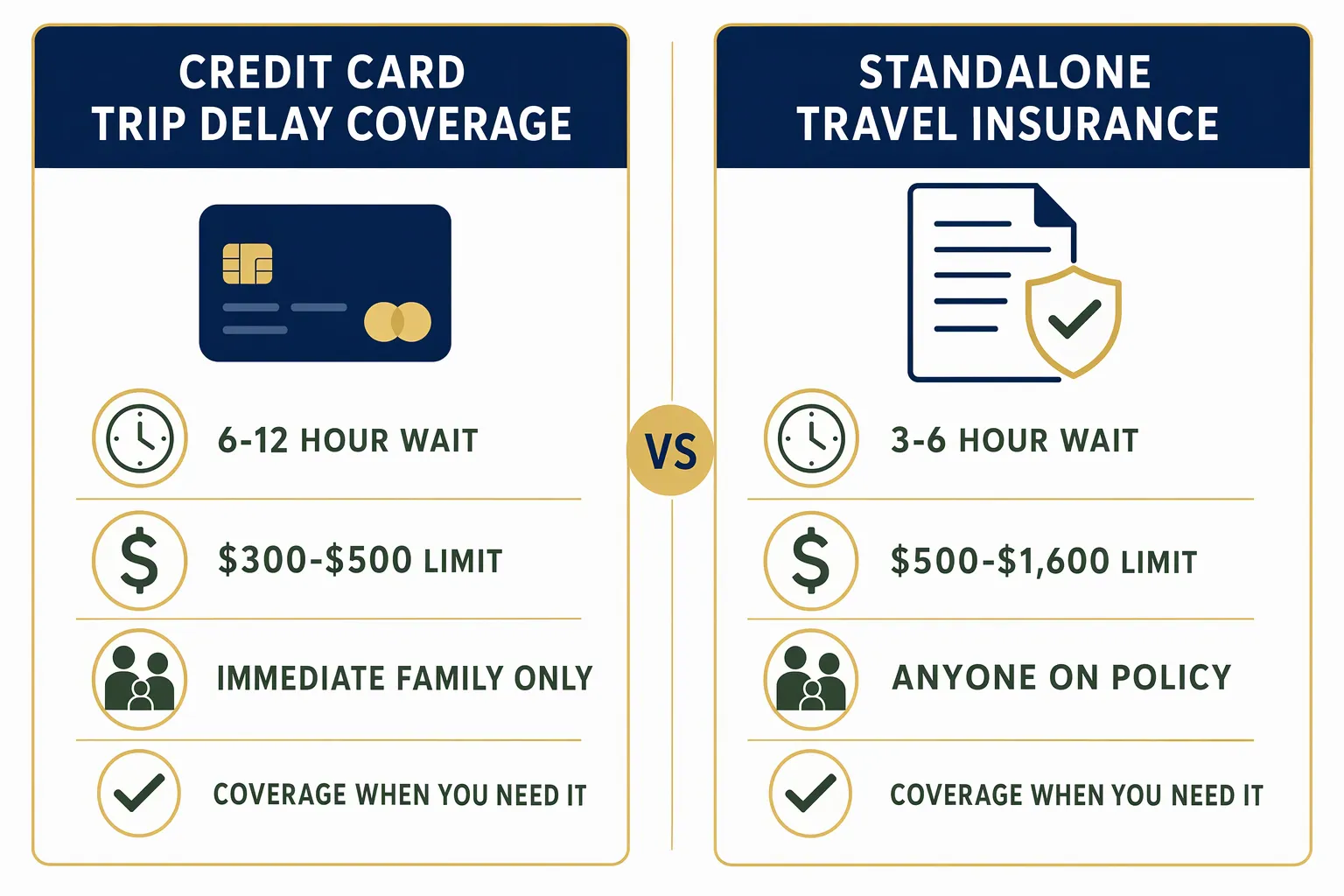
Many premium credit cards include trip delay coverage, but it differs from standalone travel insurance in important ways.
| Feature | Credit Card Coverage | Standalone Travel Insurance |
|---|---|---|
| Minimum delay | Usually 6 to 12 hours | Often 3 to 6 hours |
| Maximum reimbursement | Typically $300–$500 per person | Often $500–$1,600 per person |
| Covered reasons | May be limited (some exclude strikes or certain weather) | Usually broader set of covered events |
| Who's covered | Cardholder and immediate family only | Anyone you add to the policy |
| Receipt requirements | Usually required for all claims | Some plans pay flat daily rate without receipts |
| Cost | Included with card (but card may have annual fee) | Separate purchase, typically 4–10% of trip cost |
Credit card trip delay coverage applies only when you paid for the trip with that card, and coverage doesn't extend to friends or non-immediate family members traveling with you. The benefits end once you reach the per-trip or per-person cap, which can be quickly exhausted during a long delay in an expensive city.
Standalone travel insurance lets you tailor coverage to your trip's cost and your needs. It may also include benefits credit cards don't offer, such as coverage for pre-existing medical conditions (if purchased within a certain timeframe), medical evacuation, and cancel-for-any-reason options.
When travel insurance for delays makes sense
Travel insurance is worth considering for flight delays when:
- Your trip is expensive and includes nonrefundable bookings. If a delay causes you to miss a prepaid hotel night, tour, or cruise departure, the costs add up quickly.
- You're traveling during peak seasons or severe weather months. Winter storms, summer thunderstorms, and holiday travel bring higher delay risk.
- You're connecting through a hub known for delays or disruptions. Some airports and routes see more weather or operational issues.
- Your credit card doesn't offer trip delay coverage, or its limits are too low. A $300 cap won't cover much if you're stranded overnight in a major city.
- You're traveling with people who aren't immediate family. Credit card coverage typically won't extend to friends or extended family.
- You have tight connections for time-sensitive events. A wedding, cruise embarkation, or conference may be impossible to reschedule if a delay derails your plans.
You may not need standalone travel insurance if:
- Your bookings are refundable or flexible. If you can cancel or change plans without penalty, trip cancellation and interruption coverage offer little value.
- Your trip is short and low-cost. For a weekend getaway or a budget trip, the insurance premium may cost more than the risk of losing a few hundred dollars.
- Your credit card's trip delay coverage is strong and your trip qualifies. If you paid with a card that covers delays of six hours or more, reimburses up to a reasonable cap, and extends to everyone traveling with you, you may already be covered.
- You have an emergency fund that can absorb unexpected costs. If paying out of pocket for a hotel and meals during a delay won't strain your budget, insurance may not be necessary.
Trip delay, trip cancellation, and trip interruption: What's the difference?
Travel insurance policies use specific terms that apply to different stages of your trip:
- Trip delay coverage reimburses expenses like meals and hotels while you wait for travel to resume. Your trip is still happening; it's just delayed.
- Trip cancellation coverage reimburses prepaid, nonrefundable trip costs if you cancel the entire trip before it begins for a covered reason (such as illness, a family emergency, or a natural disaster at your destination).
- Trip interruption coverage kicks in after your trip has started. It reimburses unused prepaid costs and additional transportation expenses if you need to cut the trip short or return home early for a covered reason. It may also cover costs to rejoin a cruise or tour at the next stop if a delay makes you miss the departure.
Each has its own coverage limits, often expressed as a percentage of your total trip cost. Trip interruption coverage is typically higher (up to 150% of trip cost) because it may need to cover both lost prepaid expenses and the cost of a last-minute flight home.
What documentation to keep
If you buy travel insurance and experience a delay, keep thorough records to support your claim:
- Proof of the delay. An email or app notification from the airline showing the delay length and reason, or a screenshot of the departure board.
- Receipts for all expenses. Hotel bills, restaurant receipts, transportation costs, and any purchases for essential items.
- Your original itinerary and tickets. Proof of your planned travel and what changed.
- Communication with the airline. Records of any assistance the airline offered or declined, and whether they reimbursed any costs.
Most insurers require you to file a claim within a certain timeframe—often 20 to 90 days after returning home. Read your policy for the exact deadline and submission requirements.
What Sky Stuck offers
Sky Stuck helps you understand your rights during flight disruptions and what you're entitled to from airlines. While we don't sell travel insurance, our guides explain what airlines must provide during delays and cancellations, so you know what coverage you already have before deciding whether to buy more.
Need help navigating a flight disruption?
Visit the full Sky Stuck guide for step-by-step information on what to do when your travel plans go wrong.
Visit Sky Stuck Guide