Flight overbooked: your options explained
When a flight is oversold, you have options as a volunteer or if you're involuntarily bumped. Here's what you're entitled to and what to negotiate.
Save it in this browser to find it later.
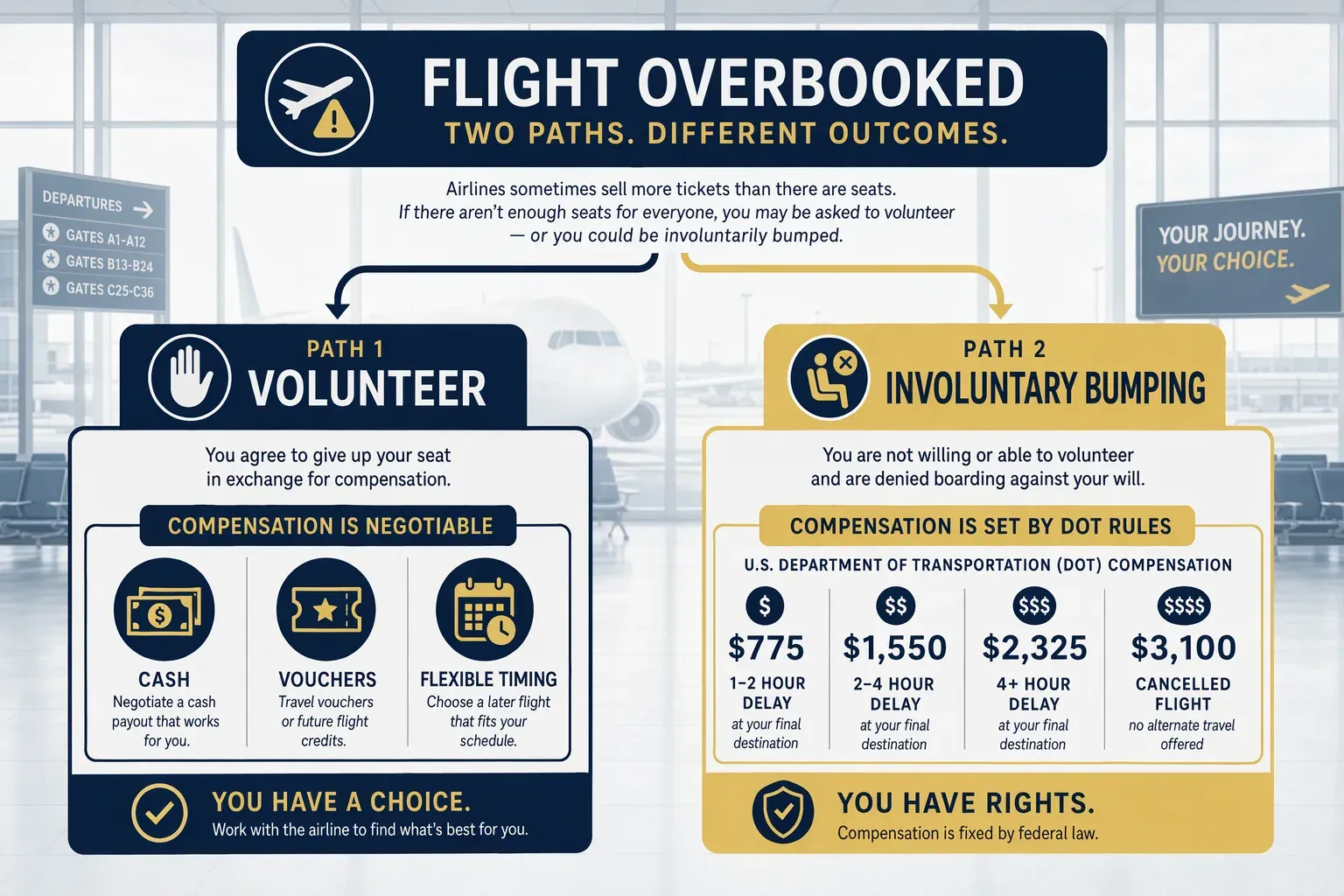
When your flight is overbooked, the airline must ask for volunteers before bumping anyone involuntarily. If you volunteer, you can negotiate the compensation; if you're bumped involuntarily, federal rules set what the airline must pay. Either way, you have rights.
Volunteering vs being bumped involuntarily
The airline asks for volunteers first. If you raise your hand, you're giving up your seat voluntarily in exchange for whatever the airline offers—there's no limit, and you can negotiate. If not enough people volunteer, the airline picks passengers to bump involuntarily based on its own criteria (often check-in time, fare paid, or frequent flyer status). Those passengers are entitled to specific compensation under Department of Transportation rules.
The key difference: volunteers negotiate, involuntary passengers get a set amount.
What you're entitled to if involuntarily bumped
If the airline bumps you involuntarily and you're flying from a U.S. airport on a domestic flight with a confirmed reservation, you checked in on time, and the airline can't get you to your destination within one hour of the original arrival time, you're entitled to denied boarding compensation (DBC).
The amount depends on how long you're delayed:
Domestic flights
| Delay at destination | Compensation |
|---|---|
| 0 to 1 hour | None |
| 1 to 2 hours | 200% of your one-way fare (up to $1,075) |
| Over 2 hours | 400% of your one-way fare (up to $2,150) |
International flights leaving the U.S.
| Delay at destination | Compensation |
|---|---|
| 0 to 1 hour | None |
| 1 to 4 hours | 200% of your one-way fare (up to $1,075) |
| Over 4 hours | 400% of your one-way fare (up to $2,150) |
Say you paid $400 for a one-way ticket and you're delayed three hours. You're entitled to $800 (200% × $400), paid the same day at the airport or within 24 hours if you're on a substitute flight that leaves before the airline can pay you.
You're not entitled to compensation if the airline substituted a smaller plane for operational reasons, if you're downgraded to a lower class (you get a refund for the price difference instead), on charter flights, on planes with fewer than 30 seats, or on international flights arriving in the U.S. from a foreign location.
The airline must give you a written statement explaining your rights and how it decides who gets bumped. It can't bump you after you've boarded—once a gate agent scans your boarding pass and tells you to board, you're on, unless there's a safety, security, health, or behavior issue.
What to negotiate if you volunteer
If you volunteer, the airline offers compensation—cash, vouchers, or travel credits—and there's no cap. You can negotiate. Before you say yes, ask:
When is the next confirmed seat? The airline might offer standby on a full flight, which could leave you waiting hours or overnight. Get a confirmed seat on a specific flight, ideally the next one that has room.
What amenities are included? If the delay is long, ask whether the airline will cover a hotel room, meals, and ground transportation. If not, you might spend your compensation on those costs.
Cash or voucher? Cash is cash. A voucher or travel credit has restrictions: expiration dates (often one year), blackout periods around holidays, limits on which routes or classes you can use it for, and whether it's transferable. If you fly that airline regularly, a $1,000 credit might be worth $1,000 to you. If you rarely fly them and the credit expires in a year, its real value is lower.
Can you afford the delay? If you're on your way home, arriving a day late might be a minor inconvenience. If you're heading to a cruise, wedding, conference, or prepaid hotel that you'll lose, the delay could cost more than the airline's offer.
Say the airline offers $600 in vouchers for a four-hour delay. If you're headed home and the next flight leaves in four hours with a confirmed seat, that might work. If you're connecting to a cruise that leaves tomorrow morning, it doesn't.
The airline must tell you if you're in danger of being bumped involuntarily and what it would have to pay if that happened. Use that as your starting point for negotiation.
When you're not at fault
If you checked in on time, arrived at the gate on time, and have a confirmed reservation, the overbooking is the airline's doing, not yours. The airline can't use criteria that cause unjust prejudice—it can't bump you based on race or ethnicity, for example—but it can use check-in time, fare, or loyalty status.
If you're involuntarily bumped, you're entitled to the compensation in the tables above plus a confirmed seat on another flight (the airline's or another carrier's). If the alternate flight doesn't get you there within the same day, the airline should provide meal vouchers and potentially a hotel, though that's up to the airline's policies and not federally required for denied boarding.
If you volunteer, you're agreeing to the delay, so the entitlements don't apply—you get what you negotiated.
When to volunteer vs push back
Volunteer when:
- Your schedule is flexible and you won't miss something you can't reschedule
- The airline offers cash or a credit you'll actually use before it expires
- The next confirmed flight works for you, and amenities (hotel, meals) are covered if the delay is overnight
- The compensation is worth more than the inconvenience
Push back or stay put when:
- You're headed to something time-sensitive (a cruise, wedding, meeting, prepaid lodging)
- The airline's only offering standby with no confirmed seat
- The compensation doesn't cover the real cost of the delay (missed hotel, lost work day, childcare)
- You can't afford to arrive late
If you're involuntarily bumped, you don't have a choice, but you do have a right to the set compensation and a written explanation. If the airline doesn't pay you or give you the statement, file a complaint with the DOT.
The flight home is usually a better candidate for volunteering than the outbound leg to something you can't miss.
Where to find your rights
The Department of Transportation publishes the full bumping and oversales rules at transportation.gov/individuals/aviation-consumer-protection/bumping-oversales, updated for 2026. If you're flying out of the EU, different rules apply under EU 261; ask the airline or check europa.eu.
If the airline doesn't follow the rules, file a complaint through the DOT's Aviation Consumer Protection form.
Sky Stuck helps U.S. travelers find clear guidance when plans go wrong. The information here is general; your rights depend on your ticket, route, and the airline's contract of carriage.
Need help navigating a flight disruption?
Visit the full Sky Stuck guide for step-by-step information on what to do when your travel plans go wrong.
Visit Sky Stuck Guide